Article Plan: Discrete Mathematics and Its Applications Rosen PDF
This article details a comprehensive guide to Kenneth H. Rosen’s pivotal textbook. We’ll explore editions, resources,
and PDF availability, covering core concepts and applications within computer science and beyond.
Kenneth H. Rosen’s Discrete Mathematics and Its Applications stands as a cornerstone text for students navigating the foundational principles of mathematics crucial for computer science and related disciplines. This widely adopted book distinguishes itself through a remarkably precise, relevant, and comprehensive approach to the subject matter. It’s designed to cater to a diverse student body, encompassing majors in mathematics, computer science, and engineering, making it exceptionally versatile.
The textbook’s enduring popularity stems from its flexibility and proven pedagogical effectiveness. Instructors consistently rely on it as a robust teaching tool. The book meticulously covers essential topics, building a strong theoretical base. Furthermore, the increasing importance of digital resources is acknowledged, with options for accessing the text as an eBook alongside traditional print versions (ISBN 9781266045479);
Students often seek PDF versions for convenient access, and resources like Semantic Scholar and GitHub repositories offer materials related to various editions, including solutions and supplementary examples. However, it’s vital to consider the legal and ethical implications of obtaining these PDFs, which will be discussed later in this article.
About Kenneth H. Rosen

Kenneth H. Rosen is a highly respected figure in the field of discrete mathematics education. He is a Professor of Mathematics at Hunter College of the City University of New York and a distinguished visiting lecturer at various institutions. Rosen’s academic background and extensive experience have profoundly shaped his approach to teaching and writing.
He is renowned for his ability to present complex mathematical concepts in a clear, accessible manner, making them understandable to a broad range of students. This talent is particularly evident in Discrete Mathematics and Its Applications, which has become a market leader due to its pedagogical strength and comprehensive coverage.
Rosen’s commitment extends beyond the textbook itself; he actively supports instructors and students through supplementary materials and resources. The availability of materials on platforms like GitHub (lair001/rosen-discrete-math-materials) demonstrates his dedication to fostering a deeper understanding of the subject. His work continues to influence the way discrete mathematics is taught and learned globally, solidifying his legacy as a leading educator.
Core Concepts Covered in the Book
Discrete Mathematics and Its Applications meticulously covers a wide spectrum of fundamental concepts. Foundational to the text is a deep exploration of logic and proofs, equipping students with the tools for rigorous mathematical reasoning. This extends into the study of sets, functions, and predicates, essential building blocks for more advanced topics.
The book delves into crucial areas like number theory, including divisibility and prime numbers, and combinatorics, focusing on counting principles and permutations. Further, it provides a robust treatment of graph theory, vital for modeling relationships and networks.
Rosen’s work also encompasses recurrence relations, Boolean algebra, and mathematical induction. These concepts are presented with a focus on practical applications, particularly within computer science. The textbook’s strength lies in its ability to connect abstract mathematical ideas to real-world problems, making it a valuable resource for students across diverse disciplines.
The Importance of Discrete Mathematics
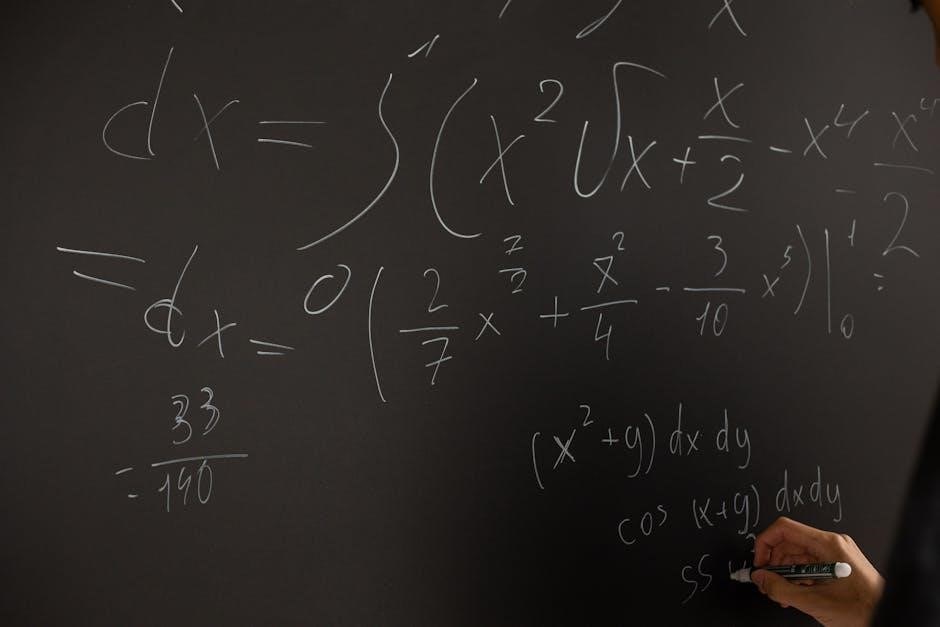
Discrete mathematics forms the bedrock of computer science and is increasingly vital in other fields like engineering and data science. Unlike continuous mathematics dealing with smooth curves, discrete mathematics focuses on distinct, separate elements – perfectly suited for the digital world.
Its importance stems from its application in algorithm design, data structures, and database management. Understanding logic and proof techniques is crucial for verifying software correctness. Graph theory underpins network analysis and optimization, while combinatorics is essential for analyzing probabilities and data sets.
Rosen’s textbook highlights these connections, demonstrating how abstract mathematical concepts translate into practical solutions. A solid grounding in discrete mathematics empowers students to tackle complex computational problems and develop innovative technologies. It’s not merely a theoretical exercise; it’s a fundamental skillset for anyone pursuing a career in the tech industry or related fields.
Target Audience and Prerequisites
Kenneth H. Rosen’s Discrete Mathematics and Its Applications is designed for a broad audience, primarily undergraduate students in mathematics, computer science, and engineering. The book accommodates diverse majors and departments, making it a versatile choice for introductory courses.
While no specific prior mathematical knowledge is strictly required, a foundation in high school algebra is highly beneficial. Familiarity with basic set theory concepts can also ease the learning curve. The textbook intentionally builds concepts from the ground up, making it accessible even to students with limited prior exposure to formal mathematical proofs;

However, students should possess a willingness to engage with abstract thinking and logical reasoning. The book emphasizes problem-solving skills, so a proactive approach to working through exercises is crucial. It’s a challenging but rewarding text, suitable for motivated learners seeking a comprehensive understanding of discrete mathematics.
Editions and Availability
Kenneth H. Rosen’s Discrete Mathematics and Its Applications has undergone several editions, each refining and expanding upon previous versions. Currently, the 7th and 8th editions are the most prevalent. The 7th edition remains a popular choice, while the 8th edition incorporates updated examples and content.
The textbook is widely available through major booksellers, both in physical and digital formats. Options include purchasing a new copy, a used copy, or renting the textbook. eBook versions are accessible through platforms like VitalSource and Amazon Kindle. ISBN 9781266045479 corresponds to a recent edition.
Availability can vary depending on location and demand. Online retailers often offer competitive pricing and convenient shipping options. Supplementary materials, such as solution manuals and instructor resources, are typically available to educators through McGraw-Hill’s website. Finding the right edition depends on course requirements and personal preference.

Where to Find the PDF Version
Locating a PDF version of Discrete Mathematics and Its Applications by Kenneth H. Rosen requires careful consideration of legality and ethics. While various websites claim to offer free PDF downloads, many are unreliable or infringe on copyright. GitHub repositories, like lair001/rosen-discrete-math-materials, provide links to the 7th and 8th edition PDFs, but these are often intended for supplemental use by students already possessing a legitimate copy.
Semantic Scholar references the existence of a 6th edition solutions PDF, indicating a demand for accessible resources. However, directly downloading unauthorized PDFs carries risks, including malware and legal repercussions. Educational institutions often provide students with access to digital versions through their library systems or learning management platforms.
Searching online using specific keywords like “Rosen Discrete Mathematics PDF” may yield results, but verifying the source’s legitimacy is crucial. Prioritize official channels and authorized distributors to ensure a safe and legal download.
Legality and Ethical Considerations of PDF Downloads
Downloading a PDF of Discrete Mathematics and Its Applications without proper authorization raises significant legal and ethical concerns. Copyright law protects Kenneth H. Rosen and the publisher’s intellectual property, making unauthorized distribution and downloading illegal. Accessing the textbook through unofficial channels often supports piracy, undermining the author’s livelihood and the publishing industry.
While the internet offers numerous sources for free PDFs, many are obtained and shared illegally. Utilizing these sources exposes users to potential risks, including malware, viruses, and legal penalties for copyright infringement. Ethical considerations extend beyond legal ramifications; respecting intellectual property rights fosters a culture of academic integrity.
Legitimate avenues for accessing the textbook include purchasing a physical copy, acquiring an authorized digital version through the publisher or educational institutions, and utilizing library resources. Supporting these channels ensures fair compensation for the author and promotes sustainable access to valuable educational materials.
7th Edition Specifics
The 7th edition of Discrete Mathematics and Its Applications by Kenneth H. Rosen represents a significant iteration of this widely-used textbook. GitHub repositories, such as lair001/rosen-discrete-math-materials, offer valuable supplementary resources specifically tailored to this edition. These include a downloadable 7th Edition PDF of the textbook itself, alongside an errata sheet detailing corrections and clarifications.
Furthermore, the repository provides a collection of slides designed to accompany lectures based on the 7th edition content. Supplemental examples are also available, enhancing understanding of complex concepts. These materials are invaluable for both students and instructors utilizing this particular version of the book.
The 7th edition maintains the book’s core strengths – a precise and comprehensive approach to discrete mathematics – while incorporating updates and refinements based on feedback and advancements in the field. Accessing the associated GitHub resources significantly enriches the learning experience.
8th Edition Updates and Changes
The 8th edition of Rosen’s Discrete Mathematics and Its Applications builds upon the established foundation of previous editions, introducing several key updates and changes. Similar to the 7th edition, supplementary materials are available via GitHub (lair001/rosen-discrete-math-materials), including an 8th Edition PDF and an accompanying errata document for identifying and correcting any potential errors.
Notably, the 8th edition features expanded sets of extra examples, designed to provide students with more opportunities to practice and solidify their understanding of core concepts. These examples complement the textbook’s existing problem sets and contribute to a more robust learning experience.
The updates also reflect evolving applications of discrete mathematics, particularly within computer science. The 8th edition aims to present the material in a way that is both theoretically sound and practically relevant, preparing students for real-world challenges. Accessing the GitHub resources alongside the textbook is highly recommended.
Supplementary Materials and Resources
Beyond the core textbook, a wealth of supplementary materials enhances the learning experience for Rosen’s Discrete Mathematics and Its Applications. A prominent resource is the GitHub repository maintained by lair001 (lair001/rosen-discrete-math-materials). This repository serves as a central hub for various aids, including slides, extra examples for both the 7th and 8th editions, and exploration materials utilizing Mathematica.
Furthermore, resources like Semantic Scholar offer access to the book itself and discussions surrounding it. Foundations of Discrete Mathematics provides logical expressions and theoretical computer science overviews, aligning with Chapter 1’s focus on logic and proofs. These materials offer a deeper dive into the foundational concepts presented in Rosen’s text.
Students can also find valuable support through online communities and forums dedicated to discrete mathematics. Utilizing these resources alongside the textbook and GitHub materials can significantly improve comprehension and problem-solving skills.
GitHub Repositories for Rosen’s Textbook
GitHub serves as a valuable repository for supplementary materials related to Kenneth H. Rosen’s Discrete Mathematics and Its Applications. The most notable repository, maintained by user lair001 (lair001/rosen-discrete-math-materials), is a comprehensive collection designed to aid students and instructors.
This repository contains resources for both the 7th and 8th editions of the textbook. Key offerings include PDF versions of the books themselves (7th and 8th editions), errata sheets for identifying and correcting errors, and a substantial collection of slides prepared for lectures.
Beyond the core textbook content, the repository also provides extra examples illustrating key concepts, categorized by edition. Furthermore, materials are included for exploring discrete mathematics using Mathematica, a powerful computational tool. This GitHub resource is a central hub for enhancing understanding and facilitating effective learning of the material.
Solutions Manual Availability
Finding a complete, legitimate solutions manual for Kenneth H. Rosen’s Discrete Mathematics and Its Applications can be challenging. While numerous websites claim to offer access, many are unreliable or require payment for potentially pirated materials. Information suggests a strong demand for the 6th edition solutions manual specifically.
It’s crucial to exercise caution when searching online, as downloading unauthorized PDFs of solutions manuals is often illegal and unethical. Legitimate solutions manuals are typically restricted to instructors and are not publicly available for free download.
Students often rely on online forums and study groups to collaborate on problem-solving, offering a viable alternative to obtaining a full solutions manual. Some instructors may also choose to provide selected solutions or hints to aid student learning. Always prioritize ethical and legal access to study materials.
Chapter 1: Logic and Proofs – A Deep Dive
Chapter 1 of Rosen’s text lays a foundational cornerstone for the entire discipline, meticulously exploring the principles of logic and proofs. It introduces propositional logic, predicate logic, and methods of logical reasoning, essential for constructing valid mathematical arguments. Key concepts include truth tables, logical equivalences, and quantifiers.
The chapter delves into various proof techniques, such as direct proof, proof by contraposition, and proof by contradiction. Understanding these methods is paramount for verifying the correctness of mathematical statements. Resources like Foundations of Discrete Mathematics provide supplementary materials covering these initial concepts.
This chapter isn’t merely theoretical; it’s directly applicable to computer science, forming the basis for program verification and algorithm design. Students will learn to translate real-world problems into logical expressions and construct rigorous proofs to demonstrate solutions.
Sets, Functions, and Predicates Explained
Rosen’s treatment of sets, functions, and predicates builds directly upon the logical foundations established in Chapter 1. Sets are introduced as unordered collections of objects, with operations like union, intersection, and complement thoroughly explained. Functions are then presented as mappings between sets, emphasizing concepts like domain, range, and injectivity/surjectivity.
Predicates, statements that evaluate to true or false depending on their inputs, are crucial for expressing properties and relationships. The chapter explores quantified predicates – universal and existential – and their logical implications. These concepts are fundamental for formalizing mathematical definitions and reasoning.
These elements are not abstract; they have direct applications in computer science, particularly in database theory, data structures, and algorithm analysis. Understanding these building blocks is essential for modeling and solving complex computational problems, as highlighted in resources accompanying the textbook.
Applications of Discrete Mathematics
Rosen’s textbook consistently emphasizes the practical relevance of discrete mathematics, showcasing its broad applicability beyond theoretical foundations. A significant portion of the book is dedicated to illustrating how these concepts underpin various fields, most notably computer science.
Examples include the use of graph theory in network design and social network analysis, logic in circuit design and artificial intelligence, and combinatorics in algorithm analysis and probability. The text also explores applications in cryptography, coding theory, and optimization problems.
Furthermore, the supplementary materials, including those found on GitHub repositories dedicated to the book, often provide real-world case studies and examples. These resources demonstrate how discrete mathematical tools are used to solve practical challenges in diverse industries, solidifying the book’s value for students seeking career paths utilizing these skills.
Discrete Mathematics in Computer Science

Discrete mathematics forms the foundational bedrock of computer science, and Rosen’s text meticulously details this crucial relationship. The book’s content directly addresses core computer science principles, including data structures, algorithms, database theory, and computational complexity.

Logical reasoning, a central theme throughout the book, is essential for program verification and artificial intelligence. Set theory and functions are fundamental to understanding data types and program design. Combinatorics and probability are vital for analyzing algorithm efficiency and modeling system behavior.
The textbook’s emphasis on proofs equips students with the ability to rigorously analyze and validate computer programs. Resources like GitHub repositories offer supplementary materials specifically tailored to computer science applications, bridging the gap between theoretical concepts and practical implementation. Understanding these concepts, as presented in Rosen’s work, is paramount for any aspiring computer scientist.
Using Mathematica with the Textbook
Kenneth H. Rosen’s Discrete Mathematics and Its Applications benefits significantly from integration with Mathematica, a powerful computational software. Several online resources, particularly those found on GitHub, provide supplementary materials designed to leverage Mathematica’s capabilities.

These resources often include Mathematica notebooks that demonstrate how to apply the textbook’s concepts to solve problems computationally. Students can use Mathematica to visualize sets, functions, and logical expressions, enhancing their understanding of abstract concepts. The software allows for experimentation with combinatorial arguments and probability calculations, verifying theoretical results.
Exploring discrete mathematics using Mathematica facilitates a deeper engagement with the material, moving beyond purely symbolic manipulation. Accessing these supplementary notebooks, often linked from repositories dedicated to Rosen’s textbook, provides a practical and interactive learning experience, solidifying comprehension and problem-solving skills.
Why Rosen’s Book Remains a Standard
Kenneth H. Rosen’s Discrete Mathematics and Its Applications continues to be a cornerstone text for students across mathematics, computer science, and engineering disciplines. Its enduring popularity stems from a precise, comprehensive approach, coupled with a relevance to modern applications.
The book’s strength lies in its pedagogical clarity and extensive problem sets, fostering a strong foundation in essential mathematical concepts. The availability of supplementary materials, including GitHub repositories with Mathematica notebooks, further enhances its value. Despite the emergence of newer texts, Rosen’s work remains highly flexible and adaptable for diverse curricula.
While PDF versions circulate, understanding the legality and ethical considerations surrounding their acquisition is crucial. Ultimately, Rosen’s textbook provides a robust and proven pathway to mastering discrete mathematics, solidifying its position as a standard in the field.